
Pune
08042783070
+919873549984
Alarm Annunciator

Alarm Annunciator 12window 2D

In stockcod not available
Phone Number

08042783070

Please keep 0 before dialling the number.

Mon-Thu: 10 AM - 2 PM • Fri: 3 PM - 7AM

Other Website Visit our other website
Address Pune , Pune Division

Pune, India, 411001

Description

The ADITYA Annunciator panel consists of a set of twelve lights that serve as a centralised indicator of the status of equipment or systems in industrial processes, buildings, or other installations. These annunciators are designed to function effectively under challenging conditions, including system vibrations, high temperatures, and dusty environments. The integration of microprocessor technology ensures high accuracy in performance. -Principle of operation : During operation, if any fault occurs, the corresponding window will start flashing, the internal buzzer will sound, and the external hooter’s C-NO contacts will close. In contrast, the trip contacts become energised, meaning the C-NOs will close and the C-NC contacts will open. Pressing the “Acknowledge“ (Ack) button will stop the flashing light, make it steady, silence the internal buzzer, and open the external hooter contact, effectively turning the external hooter off. After the fault has been cleared, pressing the “Reset“ button will restore the system to normal operating conditions. This procedure also applies to faults F2 to F12, where the outputs will be monitored accordingly. -Technical Specifications : 1. Supply Voltage : 12Vdc, 24Vdc, 48Vdc, 110Vdc, 110Vac, 230Vac or 90-260Vac/dc 2. No. of input Faults : 12 ( Faults should be potential free) 3. Output Contact rating : 5A @ 230Vac. 4. Flashing Duty cycle : 1-1.2 sec. 5. Power consumption on standby : 3VA max. 6. Power consumption on all faults : 14VA max. 7. Insulation between output contacts & internal circuit : > 10 Mohm. 8. Physical size of the unit : Overall Size : 144 (H) * 144 (V) * 150 (D) mm Cut Out size : 141 (H) mm * 141 (V) mm.

Other Products

view all

6814772a5d263414004dd4a4 Card 2

product image
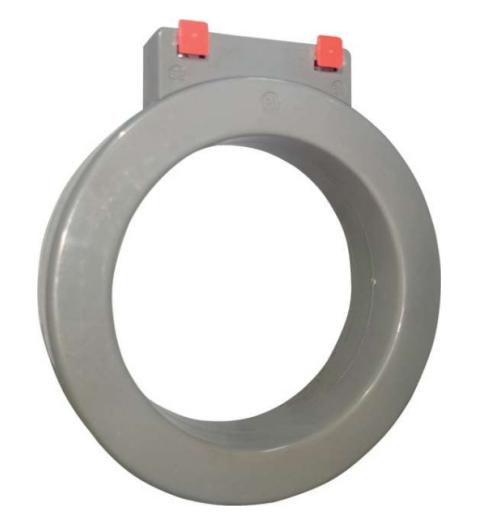
CURRENT TRANSFORMER

Available Ratios: 600/A, 800/5A, 1000/5A, 1250/5A, 1600/5A, 2000/5A or 2500/5A (also available in /1A) Burden: 5VA, 10VA, 15VA Accuracy Class: 1.0 or 0.5 Inner Diameter: 115mm Outer Diameter: 160mm Width: 40mm --What is a Current Transformer? A current transformer (CT) is used to measure large currents safely by converting them into smaller, manageable values. -The main side, where the high current is carried, is the primary, and the high current may be hundreds or even thousands of amps. This is typically the primary conductor, or a couple of turns of heavy wire. -The secondary side contains numerous turns of finer wire and carries much less current, usually 1 A or 5 A, but in the same proportion. In simple terms, it transforms a high current in the primary circuit into a lower current in the secondary circuit without changing the ratio. This relationship between primary and secondary current is called the CT ratio. For example, if the CT ratio is 1000:5: • When 1000 A flows in the primary, the secondary current is 5 A. • When 500 A flows in the primary, the secondary current is 2.5 A. Due to this reason meters and protection relays are attached on the secondary side. They are able to measure and monitor the system without being at risk of being exposed to high currents. --Uses of Current Transformer (CT) : 1. Used to measure high current safely using standard meters. 2. Supports protection relays in detecting faults and abnormal conditions 3. Provides electrical isolation to protect instruments and operators 4. Common in electrical distribution systems, switchgear and electrical panels.
6814772a5d263414004dd4a4 Card 2

product image
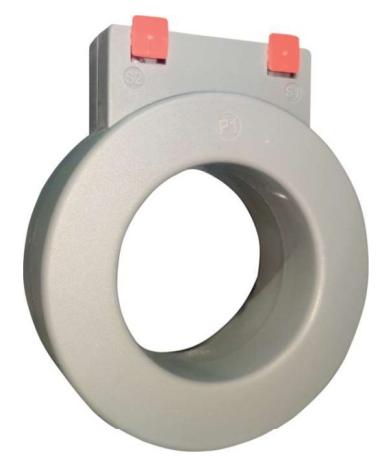
CURRENT TRANSFORMER

Available Ratios: 400/5A, 600/A, 800/5A, 1000/5A, 1250/5A or 1600/5A (also available in /1A) Burden: 5VA, 10VA, 15VA Accuracy Class: 1.0 or 0.5 Inner Diameter: 85mm Outer Diameter: 130mm Width: 40mm --What is a Current Transformer? A current transformer (CT) is used to measure large currents safely by converting them into smaller, manageable values. -The main side, where the high current is carried, is the primary, and the high current may be hundreds or even thousands of amps. This is typically the primary conductor, or a couple of turns of heavy wire. -The secondary side contains numerous turns of finer wire and carries much less current, usually 1 A or 5 A, but in the same proportion. In simple terms, it transforms a high current in the primary circuit into a lower current in the secondary circuit without changing the ratio. This relationship between primary and secondary current is called the CT ratio. For example, if the CT ratio is 1000:5: • When 1000 A flows in the primary, the secondary current is 5 A. • When 500 A flows in the primary, the secondary current is 2.5 A. Due to this reason meters and protection relays are attached on the secondary side. They are able to measure and monitor the system without being at risk of being exposed to high currents. --Uses of Current Transformer (CT) : 1. Used to measure high current safely using standard meters. 2. Supports protection relays in detecting faults and abnormal conditions 3. Provides electrical isolation to protect instruments and operators 4. Common in electrical distribution systems, switchgear and electrical panels.

6814772a5d263414004dd4a4 Card 2

product image
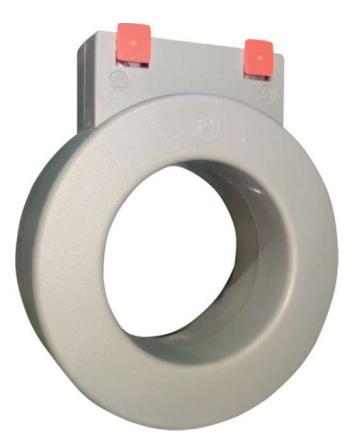
CURRENT TRANSFORMER

Available Ratios: 300/5A, 400/5A, 500/5A, 600/A, 800/5A, 1000/5A or 1200/5A (also available in /1A) Burden: 5VA, 10VA, 15VA Accuracy Class: 1.0 or 0.5 Inner Diameter: 65mm Outer Diameter: 110mm Width: 40mm --What is a Current Transformer? A current transformer (CT) is used to measure large currents safely by converting them into smaller, manageable values. -The main side, where the high current is carried, is the primary, and the high current may be hundreds or even thousands of amps. This is typically the primary conductor, or a couple of turns of heavy wire. -The secondary side contains numerous turns of finer wire and carries much less current, usually 1 A or 5 A, but in the same proportion. In simple terms, it transforms a high current in the primary circuit into a lower current in the secondary circuit without changing the ratio. This relationship between primary and secondary current is called the CT ratio. For example, if the CT ratio is 1000:5: • When 1000 A flows in the primary, the secondary current is 5 A. • When 500 A flows in the primary, the secondary current is 2.5 A. Due to this reason meters and protection relays are attached on the secondary side. They are able to measure and monitor the system without being at risk of being exposed to high currents. --Uses of Current Transformer (CT) : 1. Used to measure high current safely using standard meters. 2. Supports protection relays in detecting faults and abnormal conditions 3. Provides electrical isolation to protect instruments and operators 4. Common in electrical distribution systems, switchgear and electrical panels.